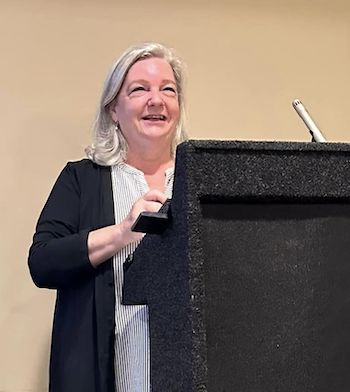
Gary Miller had the pleasure of introducing an old friend and colleague in CT Public Education. He and Margaret Dreher worked together in the Watertown Public Schools from August 2008 to June 2009 and again from July 2012 to September 2012 while he was the Interim School Business Administrator. One of the eleven functional areas of responsibility for a School Business Administrator is Child Nutrition. Counting Watertown twice he has overseen Child Nutrition programs in fourteen school districts, including one of the smallest, Preston, to one of the largest Waterbury. In his opinion Maggie is one of the best in his experience.
This is Maggie’s 24th year as a Director of Child Nutrition Programs. She spent 14 years as the Food Service Director of Watertown Schools. August 1st will be her 10th anniversary with Avon, Canton, and Region #10 as the Director of Nutrition Services. An active member of the School Nutrition Association of CT, she is a past president of SNACT as well as being awarded the School Nutrition Director of the year in 2017. She is presently the chairperson of the Public Policy and Legislation Committee. Maggie feels strongly that if we can do better for children, we should. She works with her staff to provide scratch cooked meals using local ingredients as much as possible.
Maggie reiterated that she has been doing shared services for the three school districts for ten years in a twelve-month position. Normally school nutrition services are only ten-month positions for the school year. Child Nutrition is one of the most highly regulated programs as it is covered by Federal Regulations. The service she provides is a self-operation rather than a contracted program with a school food service company. She believes self-operations provide better quality food. Prior to COVID, she included farm-to-table food sources using a local orchard and food from Sub-Edge Farm. Foods such as kale and beets were incorporated into the lunch offerings, even kale cookies and beets.
Maggie said that COVID changed the world when schools had to partially close down. Each of the school systems needed to provide emergency feeding for some students. Normally school lunches are paid by parents, but some students qualify for free or reduced price meals. During the COVID pandemic, all meals were free of charge using state and federal funding. At the end of the period the cost of meals has transitioned back and forth from free to charged. The State has infused $16 million in the 2023-24 budget to pay from students qualifying for free and reduced prices. Maggie said it would take $90 million to fully fund the lunch and breakfast programs. All schools in CT are awaiting further clarification.
Schools have been struggling with many challenges including staffing and supply chain issues. Since all school food service programs are self-funded except for state and federal support, student participation levels make a huge difference in the success or failure of these programs. Participation is much higher when the meal prices are free. She is worried about lower participation if more paid meals. She is working to restore the farm-to-table connections.
Maggie just returned from the National School Nutrition Conference. She learned that schools nationwide are learning to adjust to and accommodate "global meals" that take into effect Vegan, Vegetarian, Gluten-free, and changing tastes for ethnic and international flavors. They are able to achieve some of these dietary needs better at the high school level with more diverse cafeteria operations. Different kinds of food can be offered on a trial basis or as a voluntary option.
Greg DeManche, a former teacher and Athletic Director, asked about dealing with food waste. Maggie said this is still a problem. Two styles of food service programs are available to schools. The older style program basically means that students are served what is being offered that day, ie, all 5 food components. In the newer style students need only take 3 of the 5 components, but they must take a fruit or a vegetable. The older style had a huge waste factor. The newer style has less waste, but students still do not eat everything they take. On some days they'll take a lunch both only the the part that pleases them to supplement a lunch brought from home. They then trash everything else. Daily production records are kept to track what is served and what is taken by the students. Menu offerings are on a 5-week cycle using production records to know how much to prepare.
Don Bonner asked about breakfast programs. Most schools have an approved breakfast program in addition to the lunch program. Getting the forms completed by the families can be difficult, especially since meals have been free for the last couple of years. Also families of students coming from Hartford are not used to filling out forms since all students in Hartford are treated as free. In other school systems parents must complete the Free and Reduced Lunch/Breakfast application to determine their eligibility based on family income.
Peter Vignati ask about meal prices. Maggie said that students at the high school are charged $3.50 per lunch. They have more ala carte choices. The prices at the Elementary and Middles schools are $3.25. Adult meals are $5.00. The programs recent reimbursement from the State and Federal government to compensate the programs based on the number of free, reduced and full price meals served. Counts are reported to the state monthly to determine the reimbursement amount. Food service programs all all independent of the school operating budget, but must break even or the town needs to make up the difference from the operating budget.
Equity is a big issue. No one is supposed to know who pays and who doesn't. The Point of Sale system has the payment information. All students enter a code or use a biometric device as them come through the line. Only the person running the POS can see who is paying what. Parents use an online system to keep money on account as needed.



.png)